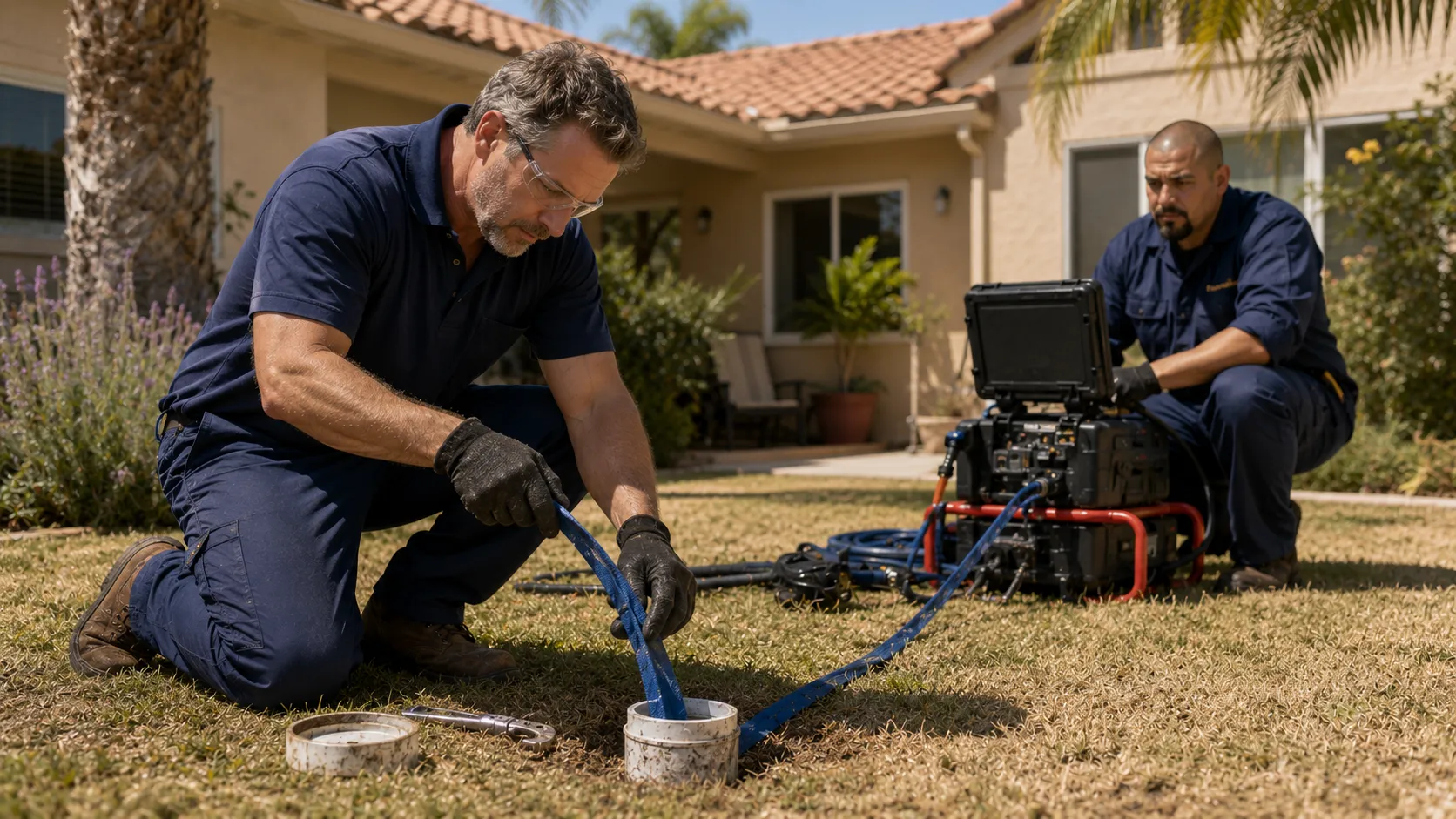
Sewer Line Repair, Dug Only Where It's Broken
Sewer line repair has a reputation for two things: surprise costs and torn-up yards. Both come from digging before anyone knows what's actually wrong. We work in the opposite order. When the line calls for it, a camera shows exactly what failed and where, so the estimate arrives in writing before a shovel touches soil and the digging stays confined to the broken section. Scheduling is fast, the service call is $0, and an active sewage backup gets a 60-minute response.
- We dig only where it's broken
- $0 service call
- Free written estimate first
- Licensed, family-owned since 2008
We repair sewer lines by excavation, done precisely, and we don’t dig blind. When the line is scoped, it tells us where to open the ground so we don’t trench a whole yard to fix six feet of pipe. If your line just needs clearing, not repair, we’ll say so and charge accordingly.
What is sewer line repair?
Sewer line repair is the fixing or replacing of the buried pipe that carries wastewater from a home to the public main, after that pipe has cracked, sagged, been invaded by tree roots, or collapsed. It differs from drain cleaning, which removes blockages from an intact pipe. Repair starts by locating the damage, often with a camera inspection to pinpoint it on video, then targeted excavation: the failed section is dug up, removed, and replaced, and the line is checked again before backfill.
No Service Call Fee
It costs nothing for us to come out and look. You get a free written estimate before any digging. The $0 covers the service call and a visual assessment: a camera run and the repair itself are quoted in the estimate.
You See What We See
The damage is located on camera and shown to you, before and after the repair. No take-our-word-for-it diagnoses.
Only Where It's Broken
Video location means targeted excavation. We open the ground over the failed section, not across the yard.
What sewer line services do we provide?
Six jobs cover the life of a residential sewer lateral, from the first warning gurgle to a full main sewer line repair. Each is diagnosed before it's dug, and every one ends with a written price you approved first.
Sewer Camera Inspection
A sewer video inspection travels the line and records what's really down there: cracks, offsets, roots, sags, or collapse, with the exact location and depth. It's the fact-finding step every honest verdict rests on.
- Cause located on video, with depth
- Footage shown to you, not just described
- The basis of every estimate we write
Spot & Section Repair
When damage is isolated, a cracked joint, a root-broken segment, a localized sag, we excavate that section alone, replace it with new PVC, and re-scope the line to prove the fix.
- Damaged length removed and replaced
- New PVC, properly bedded
- Camera re-check after the repair
Full Sewer Line Replacement
A line that has collapsed, failed in multiple places, or been destroyed by roots is past patching. Sewer line replacement runs new pipe the full length, and it ends the every-six-months backup cycle for good.
- For collapsed or extensively failed lines
- Root-resistant PVC throughout
- Verified end to end on camera
Tree Root Removal
Roots enter at joints and grow into mats that snag everything. We cut and clear them, and when they've broken the pipe itself, we excavate and replace that run with root-resistant PVC so they don't return through the same door.
- Root cutting and clearing
- Entry points assessed on camera
- Excavate-and-replace where roots won
Sewer Line Cleaning
Not every bad line is a broken line. When the camera shows an intact pipe that's blocked, cleaning solves it, and that's drain cleaning work, priced as such. We tell you which job you have, not which pays more.
- Cleaning when the pipe is sound
- Repair only when it's real
- The camera referees, on record
Signs Your Sewer Line Is Failing
Several drains slow at once. A toilet that gurgles when the tub empties. Sewage odor indoors or in the yard. One patch of lawn oddly green or soggy. A backup at the lowest drain. Two or more together: scope the line.
- Whole-house symptoms, not one fixture
- Yard signs count as much as drain signs
- A camera visit settles which one you have
How does a sewer repair actually go?
The whole method exists to answer one homeowner fear: "are they going to dig up my entire yard?" With video location, no. The ground opens where the pipe failed, and nowhere else.
Six steps, in the order they always happen.
Locate the failure
When the cause isn't obvious from the symptoms, a camera runs the line through the cleanout, end to end. The video shows what failed, how badly, and precisely where, measured by distance along the line so it can be located from the surface.
Mark the dig from the footage
The failure's position underground is transferred to a marked spot above ground. This is the step that turns "excavation" from a yard-wide event into a targeted one.
Put the verdict and price in writing
Section repair or full replacement, with the reasoning and the footage behind it. You approve a written, itemized estimate before any digging starts, and the service call to get there is $0.
Excavate the failed section
We open the ground over the damage, support the trench properly, and expose the failed pipe. Utilities are located before digging, as they must be.
Replace with new PVC and prove it
The broken length comes out. New PVC goes in, bedded and sloped correctly, joined to the sound pipe on both ends. Then the camera runs the line again, and you see the repaired section on screen.
Backfill and compact
The trench is backfilled and compacted in lifts so the ground doesn't settle into a dip over the repair. We leave the site tidy and walk you through exactly what was replaced.
Section repair or full replacement: how the call gets made.
It's the biggest-money question in sewer work, and it shouldn't be decided by a salesperson's mood. It's decided by what the camera finds. Here's the actual decision logic, case by case.
Whichever way it goes, you see the footage that made the call.
One cracked or offset joint: section repair.
Isolated damage in an otherwise sound line doesn't justify replacing the line. We dig that spot, replace that length, done.
A localized sag holding water: section repair, usually.
A belly that collects debris re-clogs forever until the sag is re-graded. If the rest of the line scopes clean, fixing the sagged run is the whole job.
Roots at one joint, pipe intact: cut first, then watch.
Cutting the roots and re-scoping on a schedule can be the right, cheaper call. When the same joint keeps admitting roots, replacing that section closes the door.
Roots through multiple joints: replacement territory.
When roots have entered at joint after joint, every joint is a future failure. Patching them one at a time costs more over five years than replacing the run once.
Any collapse: replacement of at least that run.
A collapsed segment has no repairable geometry left, and collapse usually indicates the pipe material is done. The camera tells us how far the failure extends.
Old pipe failing in several places: replace the line.
Multiple failures along one lateral is the line telling you its era is over. Serial spot repairs on failing pipe buy months apiece. Replacement buys decades.
Our thanks to the people who keep our communities running.
A 5% discount, up to $200 off, for first responders, military, healthcare workers, teachers, seniors, and nonprofit staff. Mention "Community Heroes" when you call, and we'll take care of the rest.
- First Responders
- Military
- Healthcare Workers
- Seniors
- Teachers
- Nonprofit Employees
Applies to repairs over $500. Cannot be combined with other promotions. Proof of eligibility may be requested at the time of service.
Three offices, one sewer line.
Camera rigs and excavation crews dispatch from all three All Star Plumbing offices. One number reaches the team closest to you: (866) 986-4842.
-
San Diego / Rancho Bernardo Office
11956 Bernardo Plaza Dr, Suite 147, San Diego, CA 92128
(858) 923-5989Open 24/7. Dispatch answers day and night.
-
Murrieta Office
26193 Jefferson Ave, Ste C, Murrieta, CA 92562
(951) 376-5096Open 24/7. Dispatch answers day and night.
-
Aliso Viejo Office
65 Enterprise, Suite 400c, Aliso Viejo, CA 92656
(949) 544-5101Open 24/7. Dispatch answers day and night.
Plumbing pages for your city
For response details near you, see your city's plumbing page:
Cities served by our Murrieta office
Cities served by our Aliso Viejo office
Cities served by our San Diego office
What stands behind every sewer verdict.
You don't need a corporate dispatcher and a $99 trip fee to fix a plumbing problem.
Call (866) 986-4842 to Talk to a Plumber TodayAll Star Plumbing since
Family-owned, diagnosing sewer lines on camera since 2008.
Sewer jobs completed
Inspections, section repairs, replacements, and root clearings.
Bonded & insured
A licensed California plumbing contractor, bonded and insured.
Active backups
Sewage backing up right now is answered around the clock, with a 60-minute response.
Sewer lines back in service, in their words.
Verified 5-star Google reviews from All Star customers.
John and Tyler were awesome. They came on time and solves our clogged sewer line. We were up and running within the hour!! Highly recommend this team!!
Quick response time with great service, will definitely call again.
Excellent! Fast response. Great price. Will use again.
What decides the cost of sewer line repair?
Sewer work spans a wide range, from a root cutting to a full-length replacement, and the honest price can't exist until we've seen what the line actually needs. What never varies: the service call is $0, the estimate is written and itemized before any digging, and the invoice matches what you approved.
The variables the estimate is built from
How much pipe is actually failed
One section versus the whole run is the biggest cost fork in this trade. The camera measures the damage's true extent, so you're quoted for the pipe that failed, not the pipe that didn't.
How deep the line sits
A lateral a few feet down is a modest dig. One that runs deep, as lines often do approaching the street, means more excavation, shoring, and time to reach the same pipe.
What's on the surface above it
Open lawn is the easy case. Concrete, pavers, or a driveway over the failed section add breaking and access work, and the estimate names that scope before you approve it.
Repair, or repair-plus-cause
Replacing a root-broken section without addressing the roots' entry invites a rerun. Where the fix should include root clearing or a longer replacement to close entry points, the estimate shows both paths priced.
My sewer is backing up right now, how fast can you get here?
An active sewage backup is treated as an emergency: dispatch answers around the clock, and a tech is on the way with a 60-minute response. We clear the immediate backup first so the house is usable again, then work out what caused it and put any repair in a written estimate before a shovel touches the ground.
How do I know if it's a sewer problem or just a clog?
Count the fixtures. One slow or blocked drain is almost always a local clog. Several drains misbehaving at once, a toilet that gurgles when the tub empties, sewage smell, or a backup at the lowest drain in the house all point past the fixtures to the sewer line itself. A camera run settles which it is either way.
Will you have to dig up my whole yard?
Almost never, and that’s the point of scoping before we dig. The video locates the failure by distance along the line, we transfer that to a marked spot on the surface, and the excavation happens there. A one-section failure means one dig. A full replacement is bigger by nature, but even then the trench follows the pipe, not the yard.
Who's responsible for the sewer line, me or the city?
In most California cities, the homeowner owns and maintains the lateral, the pipe from the house to the public main, and the city maintains the main itself. Where exactly your responsibility ends varies by city, and some cities put part of the lateral under the street on the homeowner too. We’ll tell you what applies where you live before any work is scoped.
How long does a sewer line repair take?
Most single-section repairs are dug, replaced, verified on camera, and backfilled within a day or two. A full-length replacement takes longer, and depth or concrete over the line stretches any timeline. The written estimate includes the expected duration for your specific job, so the answer you rely on is the one on paper.
Can tree roots be stopped permanently?
On the pipe we replace, effectively yes: modern PVC with sealed, gasketed joints gives roots no gap to enter, which is why root-destroyed sections get replaced rather than endlessly re-cut. On older clay or jointed pipe left in place, roots return to any gap they’ve found before. That’s the honest trade-off between cutting roots and replacing the run they keep invading.
Should I get a sewer inspection before buying a house?
Yes, and it’s one of the cheapest pieces of due diligence in the whole purchase. A pre-purchase sewer camera inspection shows the lateral’s actual condition: roots, sags, cracks, or a line near collapse, none of which a standard home inspection sees. Discovering a failing lateral before closing is negotiating power; discovering it after is a surprise bill.
Why do sewer lines fail in the first place?
Age and material, mostly. Older laterals were built from clay or cast iron with joints every few feet, and every joint is a place roots can enter and soil movement can shift. Add decades of ground settling and root pressure, and cracks, offsets, and sags follow. Modern PVC fails far less because it has fewer joints and they’re sealed, which is also why it’s what we replace with.
Sewer trouble? Get the camera's verdict before anyone digs.
A licensed tech, a $0 service call, and a written estimate before any excavation. If it only needs cleaning, that's what we'll tell you.
All Star Plumbing · Licensed & Insured, California · 24/7: (866) 986-4842