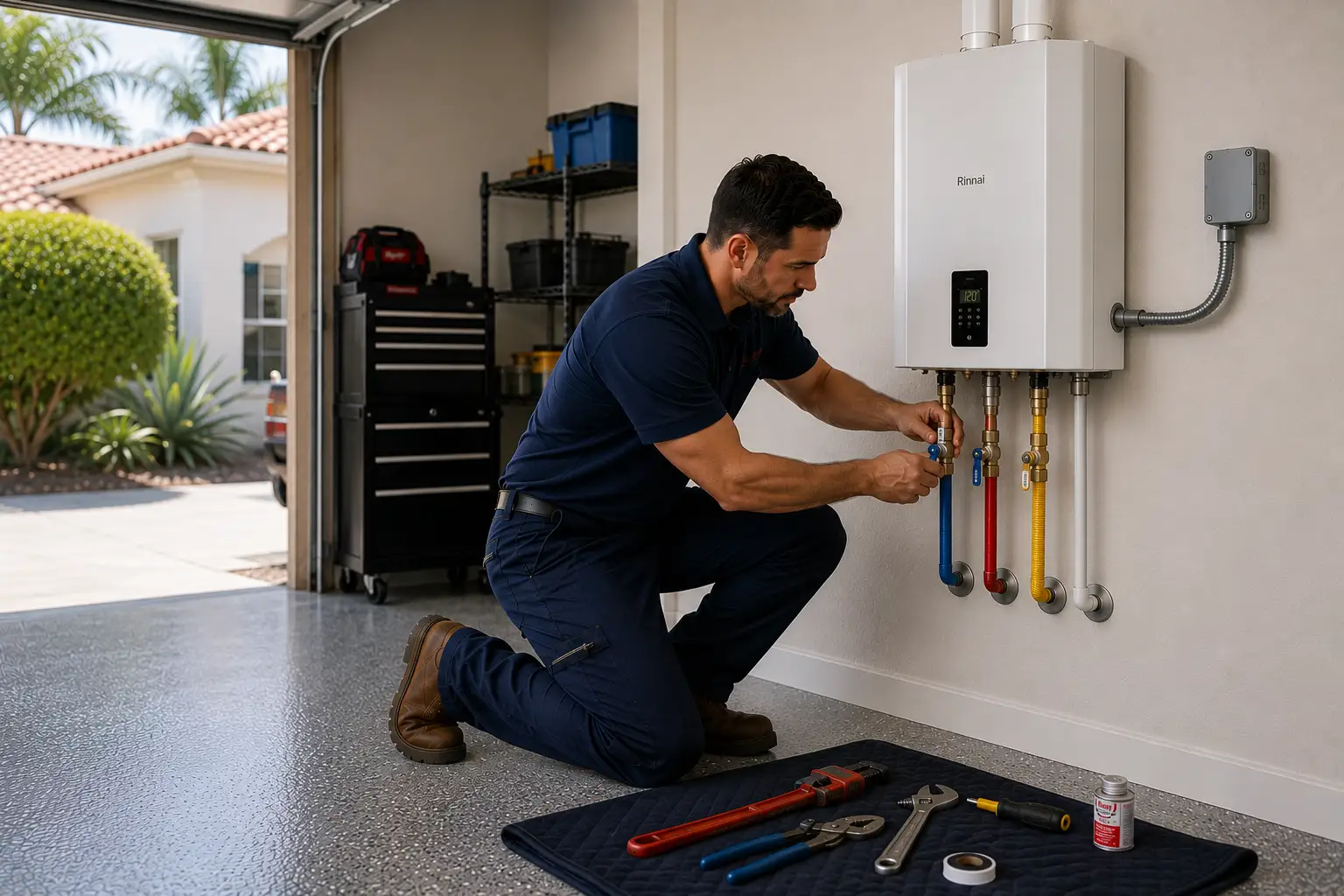
Water Heater Repair & Tankless Installation
Water heater repair starts with a question most companies skip: what actually failed? A dead heater might need a simple part. A corroded tank needs replacing. The two deserve very different quotes, and the visit that tells us which one you have is $0. All Star Plumbing services standard gas and electric tanks and gas tankless units. Repair, replacement, new installation, and the maintenance that keeps them alive. No hot water at all, or a tank actively leaking? That's an emergency to us, answered 24/7 with a 60-minute response.
- Tank & tankless
- $0 service call
- Free written estimate before any work
- Licensed, family-owned since 2008
Straight talk: a corroded, leaking tank gets replaced, not patched. When a repair is the right call, that’s what we’ll quote. Either way you see the price before we start.
What does water heater repair include?
Water heater repair is the diagnosis and part-level fix of a unit that has stopped making hot water, makes too little, or shows a fault. Repairable parts include heating elements, thermostats, igniters, thermocouples, gas control valves, and anode rods, on a tank or tankless unit whose body is still sound. When the tank itself has corroded and leaks, repair is no longer possible and the unit is replaced. All Star Plumbing handles both paths. The service call is $0, and you get a written estimate before any work.
No Service Call Fee
It costs nothing for us to come out and look at the heater. You get a free written estimate before any work.
Most Replacements, Same Day
Common gas and electric sizes ride with us. When the tank has failed, we usually replace it the same visit.
Installed to Code
Every replacement is permitted where required and set up to code. Seismic straps, an expansion tank, correct venting, and a T&P line.
What can go wrong with a water heater?
Every symptom below has a known cause and an honest fix. Hot water heater repair is mostly pattern recognition. The trick is telling the fixable patterns from the end-of-life ones, and that is exactly what our visit settles, at $0 for the service call.
No Hot Water, or Not Enough
Total loss points to ignition or power: a pilot, igniter, element, or gas valve. Hot water that runs out too fast points to sediment, a failed lower element, or an undersized unit.
- Pilot, igniter, and element service
- Thermostat and gas valve repair
- Capacity honestly assessed
A Tank That's Leaking
Leaks from a fitting or valve are repairable. A leak from the tank body itself means the steel has rusted through from the inside. No sealant or weld makes that safe. That unit gets replaced, usually same day.
- Fitting and valve leaks repaired
- Body leaks: replacement, honestly
- Old unit hauled away
Rusty or Discolored Hot Water
Brown or rust-tinted hot water usually means the anode rod is spent and the tank interior has started corroding. Caught early, a new anode can halt it. Caught late, it's the countdown to a body leak.
- Anode rod inspection
- Corrosion staged honestly
- Replacement timed, not forced
Rumbling, Popping, Crackling
That's water flashing to steam under a blanket of sediment. Southern California's hard water builds the blanket fast. A flush removes it, restores efficiency, and quiets the tank if the steel is still sound.
- Sediment flush
- Efficiency and recovery restored
- Honest call if it's too far gone
Tankless Repair & Installation
Tankless water heater repair means fault codes, ignition failures, and scale-restricted flow. Installation means new units and full tank-to-tankless conversions, with the gas, venting, and condensate work done to code.
- Fault-code diagnosis and repair
- Descaling for restricted flow
- New installs and conversions
Water Heater Service & Maintenance
An annual flush, an anode check every few years, and a T&P valve test: three small jobs that decide whether a tank dies at eight years or lives past twelve. We do all three in one visit.
- Annual sediment flush
- Anode rod replacement when spent
- T&P safety valve tested
How we get from symptom to hot water.
The order below exists because water heater work has one expensive trap: replacing a unit that needed a part, or repairing a unit that needed replacing. Diagnosis first makes both mistakes impossible, and the visit it starts with costs you nothing.
Five steps, same sequence every time, whether the fix is a thermocouple or a full tankless conversion.
Diagnose before anything is quoted
Power or gas supply, ignition, elements or burner, thermostats, anode, tank condition. On tankless, the fault code and the heat exchanger. Fifteen minutes of testing tells us which failure pattern we're in.
Apply the repair-or-replace frame, openly
Three inputs decide it. Age: past ten years, failure risk climbs sharply. Cost: the repair priced against a new unit. History: repeat failures mean the unit is telling you something. One override: a leaking tank body is always a replacement. You see the same math we do.
Size the replacement to the household
A tank is sized in gallons, 40 to 50 for most homes, matched to how you actually use hot water. A tankless is sized differently, by flow rate and temperature rise. Oversizing wastes money and undersizing wastes mornings. We aim for neither.
Install to California code, with reasons
The permit makes the work inspectable. Two seismic straps keep a full tank upright in a quake. The expansion tank absorbs thermal pressure a closed system can't. Correct venting and a T&P discharge line handle exhaust and overpressure safely. Each item is on the estimate because each does a job.
Prove it works, then leave it clean
Fill, purge, leak-check, fire, verify the T&P, confirm temperature at the faucet. The old unit leaves with us. You get a plain-language rundown of what was done and the maintenance rhythm that keeps the new unit out of trouble.
Tank or tankless: the honest comparison.
Both are good technology. The right one depends on your home, your usage, and your appetite for upfront cost. Here's the trade-off, dimension by dimension, with no thumb on the scale.
We install and service both, so we genuinely don't care which you pick. We care that you pick with the full picture.
Upfront cost: tank wins.
A standard tank swap is the cheaper install by a wide margin. A tankless unit costs more itself. A first-time conversion also adds gas-line upsizing, new venting, and a condensate drain. That's a 4 to 8 hour job, not a swap.
Lifespan: tankless wins.
A conventional tank runs 8 to 12 years. Tankless units run 15 to 20 or more with descaling. Over two decades, one tankless can outlast two tanks. That's how the higher upfront cost earns itself back.
Hot water pattern: different, not better.
A tank delivers strong flow until it empties, then you wait. A tankless never empties, but it caps how much can run at once. Two showers and a dishwasher can outrun a small unit. Sizing by flow rate is what makes tankless feel endless.
Space: tankless wins.
A wall-mounted tankless frees the floor footprint of a 40-plus gallon tank. In a tight garage, a closet, or a small utility room, that reclaimed space is a real benefit, not a brochure line.
Maintenance: a tie, honestly.
Tanks want an annual flush and periodic anode replacement. Tankless wants periodic descaling, especially in hard-water areas. Neither is maintenance-free. Skipping it shortens both units' lives.
Efficiency: tankless wins, with a caveat.
Heating water only on demand beats keeping 50 gallons hot around the clock. The caveat: the savings are real but modest month to month. Efficiency alone rarely justifies a conversion. Lifespan and space are the stronger reasons.
Our thanks to the people who keep our communities running.
A 5% discount, up to $200 off, for first responders, military, healthcare workers, teachers, seniors, and nonprofit staff. Mention "Community Heroes" when you call, and we'll take care of the rest.
- First Responders
- Military
- Healthcare Workers
- Seniors
- Teachers
- Nonprofit Employees
Applies to repairs over $500. Cannot be combined with other promotions. Proof of eligibility may be requested at the time of service.
Three offices, one water heater line.
Water heater calls dispatch from all three All Star Plumbing offices, with common tank sizes stocked to make same-day replacement possible. One number reaches the team closest to you: (866) 986-4842.
-
San Diego / Rancho Bernardo Office
11956 Bernardo Plaza Dr, Suite 147, San Diego, CA 92128
(858) 923-5989Open 24/7. Dispatch answers day and night.
-
Murrieta Office
26193 Jefferson Ave, Ste C, Murrieta, CA 92562
(951) 376-5096Open 24/7. Dispatch answers day and night.
-
Aliso Viejo Office
65 Enterprise, Suite 400c, Aliso Viejo, CA 92656
(949) 544-5101Open 24/7. Dispatch answers day and night.
Water heater pages for your city
For service details near you, see your city's water heater page:
Cities served by our Murrieta office
Cities served by our Aliso Viejo office
Cities served by our San Diego office
What stands behind every water heater job.
You don't need a corporate dispatcher and a $99 trip fee to fix a plumbing problem.
Call (866) 986-4842 to Talk to a Plumber TodayAll Star Plumbing since
Family-owned, diagnosing and installing water heaters since 2008.
Water heaters serviced
Repairs, replacements, installs, and maintenance visits, tank and tankless.
Bonded & insured
A licensed California plumbing contractor. Installs permitted and set to code.
No-hot-water emergencies
A dead heater or an active leak is answered around the clock, with a 60-minute response.
Hot water restored, in customers' words.
Verified 5-star Google reviews from All Star customers.
I had John and helper come out on a Sunday evening when my water heater quit on me . Got it replaced and had hot water in a quickly manor. Definitely recommend these guys
Our tenant reported a leak, and I wanted it fixed quickly because they're a family with two kids, and I knew living without water would be tough. John came out within an hour and replaced the water heater and brought it up to code. Amazing work, and super professional! Will definitely call again when the need arises.
Sergio did an amazing job with my leak issue at my home. He tested everything and was very thorough and knowledgeable about what needed to be done and explained everything to me. Being a Master plumber it was evident he knows what he's doing. He was very thorough with everything. He even fixed my water heater connection that was done wrong and also made a nice box for my refrigerator water and ice line. He's super neat and cleaned up great. If you ever need a great plumber call and ask for Sergio. You won't be disappointed plus he's nice!
Why water heater quotes vary so much, explained.
Two neighbors can get quotes for "a new water heater" that sit far apart. Both can be fair, because the quotes contain different jobs. Here's what's actually inside the number, so you can compare any estimate, including ours, like-for-like. The service call is $0. Every figure reaches you in writing before work starts.
What's inside a water heater quote
The path: part, tank, or tankless
A part-level repair on a sound unit is the smallest job. A like-for-like tank swap is the middle. A tankless conversion, with its gas, venting, and condensate scope, is the largest. The diagnosis places you honestly on that ladder.
The code work bundled in, or left out
Straps, expansion tank, venting corrections, T&P discharge, pan, permit. A low quote that omits these isn't cheaper, it's incomplete. Ours itemizes each so you can see exactly what's included.
Capacity and fuel
Gallons, flow rate, gas versus electric: equipment cost scales with size and type. We size to the household's real usage, never to the biggest unit available.
What the old install left behind
A clean previous install swaps fast. Corroded fittings, out-of-code venting, or a cramped location add correction work, and that shows up as its own line, not a surprise.
Can a leaking water heater tank be repaired?
If the leak is at a fitting, valve, or connection: yes, that’s a normal repair. If the tank body itself is weeping, no. Anyone who offers to seal it is selling you a delay. A body leak means the steel has corroded through from the inside, and the only safe fix is replacement. Our visit tells you which leak you have, and the service call to find out is $0.
What's the difference between repairing a gas and an electric water heater?
The failure points differ. Gas units fail at the pilot, thermocouple, igniter, or gas control valve; electric units fail at the heating elements and thermostats, usually the lower element first. Electric repairs need the breaker off, gas repairs need the gas isolated. Same diagnosis process, same written estimate either way.
How long does a water heater installation take?
A like-for-like tank swap typically runs two to three hours, including code items and haul-away. A tank-to-tankless conversion is a different animal. Gas-line upsizing, new venting, and a condensate drain make it a 4 to 8 hour job. Either way you’ll know the expected window before work starts.
Do tankless water heaters really give endless hot water?
Endless in duration, capped in volume. A tankless never runs out the way a tank does, but it can only heat so many gallons per minute. Run too many things at once and an undersized unit falls behind. Sizing by flow rate and temperature rise is what makes “endless” true in practice.
What does water heater maintenance actually include?
Three jobs. A sediment flush drains the mineral buildup that causes rumbling and lost efficiency. An anode rod check replaces the sacrificial rod that corrodes so the tank doesn’t (it depletes in roughly three to five years). A T&P valve test confirms the safety valve opens under pressure like it should. Together they’re the difference between a tank that reaches twelve years and one that quits at eight.
Should I turn my water heater off when I go on vacation?
For a week or more, yes. Turn a gas unit to its vacation or pilot setting, and an electric one off at the breaker. There’s no point keeping 50 gallons hot for an empty house. More important: close the cold supply valve to the heater. If anything fails while you’re gone, that one turn limits the flood to a tank’s worth instead of a mainline’s worth.
What is an anode rod, and why does everyone keep mentioning it?
It’s a metal rod inside the tank designed to corrode first, so the steel tank doesn’t. Chemistry attacks the rod before the steel. Once the rod is consumed, usually in three to five years, the tank itself starts rusting, and that only runs one direction. A rod costs little and a tank costs a lot. That’s why the anode check earns its place in every maintenance visit.
When does replacing a water heater make more sense than repairing it?
Three signals, any two together: past ten years old, a repair quote near half the cost of a new unit, or repeat failures. And one absolute: a leaking tank body is always a replacement. Under those lines, repair is usually the honest recommendation, and it’s the one we’ll make.
Hot water problems? Start with the $0 service call.
Tank or tankless, repair or replacement: a licensed tech, a $0 service call, and a written estimate before any work. If a repair is the right call, that's what we'll quote.
All Star Plumbing · Licensed & Insured, California · 24/7: (866) 986-4842